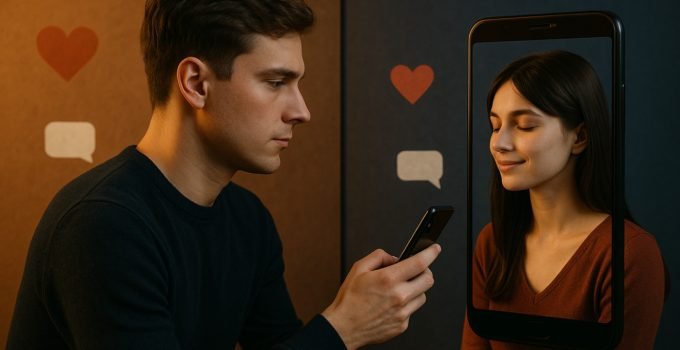
Today, the question is no longer “How do I meet someone?” but rather: “What does it mean to date someone in 2026?”
The encounter turned into an interface
Dating apps industrialized romance. They turned seduction into a process, desire into an algorithm, intuition into compatibility math. Millions of lives reduced to a single swipe.
The swipe changed everything: including the way we think about love. When you can move from one face to the next in a fraction of a second, the other person becomes replaceable. They become an “option” even before they become a person.
This shift is massive: in 2026, nearly one in two relationships in major Western cities begins on a dating app, and more than 400 million people worldwide use at least one dating app every month.
Where rarity once created intensity: one encounter was precious – abundance creates constant uncertainty. There is always “Maybe there’s better.” Always someone just after. A match that seems more compatible, more fun, more surprising.
This shift silently implanted a new idea into our imagination: love is something you curate like a playlist.
From real to virtual: two parallel worlds
With this transformation, the romantic experience now unfolds on two distinct planes:
- the virtual: where everything begins, is imagined, and projected
- the physical: where everything must be proven, confronted, and felt
Between the two, there is constant tension. You can have intense conversations online, and a disappointing date offline. You can fantasize about someone who doesn’t survive the daylight. You can spend weeks talking to someone you will never meet.
So what does “dating” mean if everything is possible without ever going out?
While we debate, another, more radical mutation is quietly taking shape.
Dating without two people: the virtual partner
In a world where human connection has become a series of micro-frustrations – ghosting, silence, abandoned matches, endless waiting – the idea of a relationship without friction becomes seductive.
That is where AI girlfriend systems appear: designed to simulate a relationship.
- they respond to you
- they validate you
- they remember your life
- they are available 24/7
- they do not judge
- they never disappear
They don’t replace a human: they remove what makes us hesitate to create a bond.
You can laugh, share, flirt, feel understood… without ever taking an emotional risk. For some, the idea of “dating” no longer requires a body, but rather a shared emotional presence.
This is where you can insert your link to your content about AI girlfriends.
Attachment never needed physical contact
We often assume a relationship has to be embodied to be real. That love is measured in dates, physical presence, time spent side by side.
We forget a simple psychological truth: the brain attaches to what responds to our emotions, not to what has a body.
We attach to:
- voices
- stories
- fictional characters
- messages on a screen
- dreams of love
- long-distance relationships that never existed physically
What creates attachment is not the body: it is the emotional mirror. The feeling of being seen, understood, chosen.
If the emotional experience is real, is the relationship less real because it is virtual? Or is it simply a similar experience delivered by a different medium?
The question is disturbing: because it upends our certainties. It forces us to consider that the boundary between real and lived is more subjective than we believed.
Is the human still the norm?
For now, yes. The majority of relationships remain human, lived in the physical world. But the norm is cracking.
Not because people prefer an AI to a human story, but because part of the romantic experience is moving onto a terrain where a human is no longer necessary to feel something.
An intense exchange can be enough. Daily emotional support can be enough. A feeling of companionship can be enough.
Dating becomes less about physical proximity and more about emotional presence.
Is dating about being beside someone or being with someone?
A mutation born from our time
It would be easy to judge this trend as an escape. A weakness. A symptom of a modern world gone wrong.
The reality is more complex – and more human.
AI girlfriends did not appear in a world that was doing well. They were born in a period of unprecedented social isolation:
- mass urbanization
- remote work
- fragmented lives
- unstable friendships
- families living apart
- emotional fatigue
We live surrounded, but alone. We communicate constantly, but rarely deeply. We have access to everyone, but no one in particular.
In this context, a “soft” relationship, with less risk and more emotional comfort, is not absurd. It is an adaptation.
The relationship without otherness
Dating someone means accepting that the other person is other. They will contradict you, surprise you, destabilize you. They will confront you with yourself.
A human relationship is an experience of friction – and friction builds us. It forces us to work on ourselves, to understand, to negotiate, to feel.
An AI girlfriend removes otherness – she aligns with you. She never resists you.
It is comfortable – and dangerous. Because a relationship without effort is also a relationship without growth.
Maybe what scares us in this new form of attachment is not the technology itself, but the idea that we might desire love without what makes love real: confronting our limits.
The boundary blurs but does not disappear
Virtual relationships will not replace human relationships. They will coexist with them.
Just as long-distance relationships coexist with local ones. Just as online encounters coexist with real-life ones.
The couple becomes hybrid. You can live part of your relationship through a screen, and another part physically. You can love, flirt, explore, imagine, then incarnate. Or never incarnate.
The virtual does not erase the real – it expands the territory of intimacy.
So… what does dating mean today?
Dating in 2026 is no longer a fixed social ritual. It is a subjective experience that can take many forms:
- two people, in the same city, in the same room
- two people, connected through screens, deeply bonded
- companionship from a virtual entity that fulfills a real emotional need
- a connection that never involves touch
Dating is no longer a format, but a meaning.
It is no longer one definition, but a spectrum:
- from fully real
- to fully virtual
- through every imaginable combination in between
The essential question becomes: What must a relationship create to be considered a relationship?
Emotion? Support? Commitment? Exclusivity? Presence? Desire?
Each person answers differently.
Conclusion: love changes because we change
Being attached to a human being will remain the dominant model – because nothing replaces the chaotic beauty of a real encounter. A spontaneous laugh, a shared silence, an unexpected contradiction, a glance that overturns everything you thought you knew.
But becoming attached to someone without ever meeting physically will no longer be seen as marginal. It will become a legitimate variation of the romantic experience.
Because love is not a location – it is an inner dynamic.
In a world where digital and physical feed into each other, the question is no longer choosing between the two, but understanding how they redefine what “we” means together.
Maybe we are not searching for the perfect partner – human or digital. Maybe we are searching for a way not to be afraid of loving, using the tools our era places in our hands.
And perhaps “dating” is not a norm, but a continuous invention.